Every email list has a quiet problem hiding inside it: customers who bought once, looked engaged, and then disappeared. They are still on your list. They still recognize your brand. But they have stopped opening, clicking, and buying. A win-back flow in Klaviyo is the automated system that brings those lapsed customers back before they churn for good.
Building a win-back flow in Klaviyo is one of the highest-leverage automations you can run, because re-engaging an existing customer almost always costs less than acquiring a new one. The hard work of earning trust and making the first sale is already done. You simply need a structured way to remind people why they chose you and give them a reason to return.
This guide walks through what a win-back flow is, when it should trigger, how to structure the messages, which segments to target, and the common mistakes that quietly kill performance. By the end, you will have a clear blueprint you can build inside your own Klaviyo account.
What is a Win-Back Flow in Klaviyo?
A win-back flow in Klaviyo is an automated email or SMS sequence that targets customers who have not purchased or engaged within a defined period of time. Its goal is to reactivate lapsed buyers, recover at-risk revenue, and keep your sending reputation healthy by re-engaging or sunsetting inactive contacts.

Unlike a one-off re-engagement campaign, a win-back flow runs continuously in the background. Once a customer crosses your inactivity threshold, Klaviyo automatically enters them into the sequence, sends a series of timed messages, and then routes them based on whether they re-engage.
The flow typically relies on predictive and behavioral data that Klaviyo already tracks, such as last purchase date, average time between orders, and historical engagement. This is where Klaviyo separates itself from basic email tools. Instead of guessing who is lapsing, you can use real customer data to trigger the right message at the right moment. If you want a broader view of how this fits into a complete automation strategy, our guide on the top 10 email flows every Shopify store should set up in Klaviyo shows where win-back sits alongside your other core flows.
Why a Win-Back Flow Matters for E-Commerce Revenue
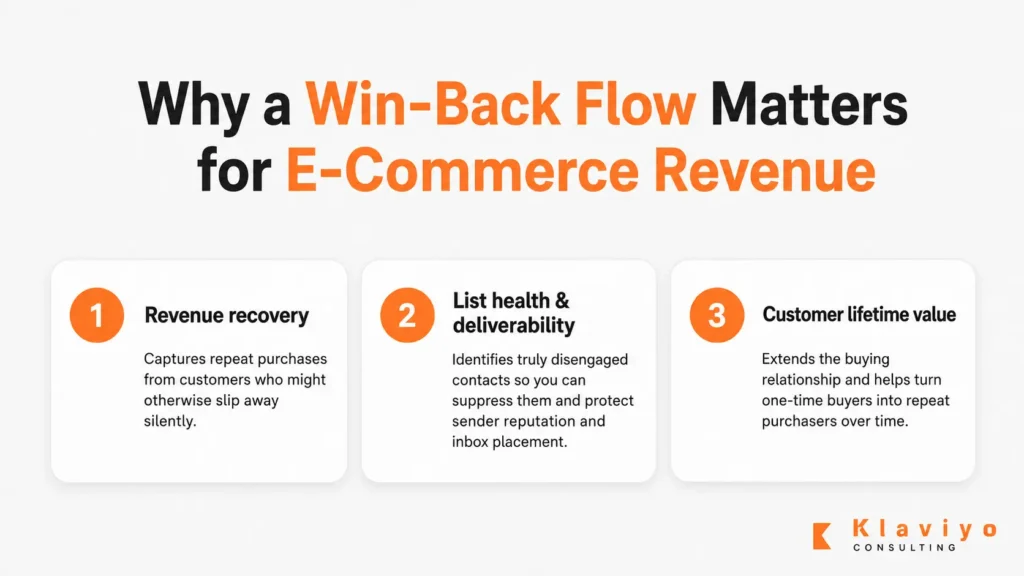
Lapsed customers represent revenue you have already earned the right to pursue. They have proven they will pay, which makes them far more valuable than a cold lead. A well-built win-back flow protects that value in three ways.
- Revenue recovery: It captures repeat purchases from customers who would otherwise slip away silently.
- List health and deliverability: It identifies genuinely disengaged contacts so you can suppress them, which protects your sender reputation and inbox placement.
- Customer lifetime value: It extends the buying relationship, turning one-time buyers into repeat purchasers over time.
The deliverability angle is often overlooked. Continuing to email people who never open your messages drags down your engagement metrics and signals to inboxes that your sends are unwanted. According to Klaviyo’s official guidance on sunset flows and list cleaning, removing disengaged profiles helps protect your sender reputation and inbox placement. A win-back flow gives those contacts one last structured chance to re-engage, then helps you clean your list responsibly. For a deeper look at protecting inbox placement, see our breakdown of how to improve deliverability in Klaviyo through warming, domains, and IPs.
Work With a Klaviyo Consultant Who Builds Flows That Convert
A win-back flow only recovers revenue when the targeting, timing, and messaging are dialed in correctly. If you would rather have an expert build and optimize your automations from the start, explore our Klaviyo consultant services to see how hands-on flow strategy can turn lapsed customers into repeat buyers.
When Should a Win-Back Flow Trigger?
The trigger is the most important decision in your entire flow, because sending too early annoys active customers and sending too late wastes the window to recover them. The right timing depends on your product and purchase cycle.
A consumable product like coffee or skincare has a short, predictable reorder cycle, so a customer who has not bought in 60 days may already be lapsing. A considered purchase like furniture or electronics has a much longer natural gap, so 60 days of silence is normal and 180 to 365 days might be the real signal.
The strongest approach uses Klaviyo’s predictive analytics. Klaviyo can estimate each customer’s expected next order date and average time between orders, which lets you trigger the flow relative to individual behavior rather than a single fixed number. To go deeper on this data-driven method, our article on using Klaviyo’s predictive analytics to drive repeat purchases explains how to put these metrics to work.
As a practical starting point, many stores trigger a win-back when a customer has not placed an order in roughly 1.5 to 2 times their average purchase interval, with a minimum threshold so you never re-engage someone who just bought.
Win-Back Flow Structure: A Message-by-Message Table
A win-back flow works best as a short, escalating sequence rather than a single email. The table below outlines a proven four-to-five message structure you can adapt to your brand.
| Message | Timing | Goal | Suggested Content |
| 1. The Reminder | Day 0 (entry) | Reopen the relationship warmly | “We miss you” message, highlight new arrivals or best-sellers, no discount yet |
| 2. The Value Nudge | Day 4–5 | Remind them why you’re worth it | Showcase benefits, social proof, reviews, or product education |
| 3. The Incentive | Day 8–10 | Give a concrete reason to return | Time-limited discount, free shipping, or loyalty perk |
| 4. The Urgency | Day 12–14 | Create a deadline | Reinforce the expiring offer, emphasize scarcity or last chance |
| 5. The Sunset Check | Day 16–18 | Re-confirm interest or suppress | Ask if they still want to hear from you; suppress non-responders |
The principle behind this order is simple: lead with value, not discounts. If you open with a coupon, you train customers to lapse on purpose to earn rewards. Hold the incentive until the middle of the sequence, after a softer reminder and a value-driven message have failed to convert.
Each message should include a conditional split. If the customer purchases or re-engages at any point, they should exit the flow immediately so they never receive the remaining “we miss you” messages after they have already come back.
How to Segment Customers for a Win-Back Flow
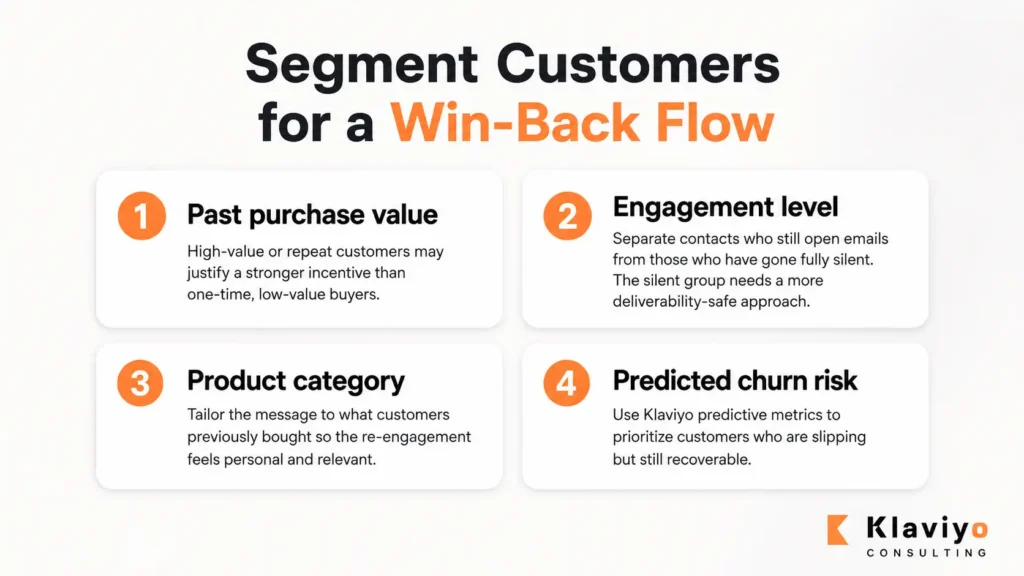
Not every inactive contact deserves the same treatment, and segmentation is what separates a profitable win-back flow from a wasteful one. A first-time buyer who lapsed behaves very differently from a former VIP who used to order monthly.
Consider building segments around these criteria:
- Past purchase value: High-value or repeat customers may justify a stronger incentive than one-time, low-value buyers.
- Engagement level: Separate contacts who still open emails from those who have gone fully silent, since the silent group needs a different deliverability-safe approach.
- Product category: Tailor the message to what they previously bought so the re-engagement feels personal and relevant.
- Predicted churn risk: Use Klaviyo’s predictive metrics to prioritize customers who are slipping but still recoverable.
Strong segmentation also keeps your incentives efficient. There is no reason to offer a generous discount to a customer who responds to a simple reminder. To build these segments well, our guide to 7 powerful Klaviyo segmentation strategies is a useful companion resource.
Personalizing Your Win-Back Messages
Generic “we want you back” emails are easy to ignore. The flows that recover the most revenue feel like they were written for one person, because Klaviyo’s dynamic content lets you reference real customer data.
You can pull in the customer’s first name, the specific product or category they last purchased, the date of their last order, or even recommended products based on their history. A line like “It’s been a while since your last order of [last product]” lands far harder than a faceless discount blast.
This level of personalization runs on dynamic tags and custom properties inside Klaviyo. If you want to master that mechanic, our walkthrough on personalizing Klaviyo emails with dynamic tags and custom properties covers exactly how to set it up.
Want Experts to Handle the Strategy Behind Your Flows?
Building flows is part technical setup and part strategic judgment about timing, segmentation, and messaging. Learn more about our Klaviyo consultants and how a specialist team approaches re-engagement so every automation you run is built to recover revenue, not just send emails.
Common Win-Back Flow Mistakes to Avoid
Even well-intentioned win-back flows underperform when a few avoidable errors slip in. Watch for these:
- Leading with a discount trains customers to disengage on purpose to unlock rewards.
- Using one fixed trigger window for every product ignores how purchase cycles differ across categories.
- Forgetting an exit condition keeps emailing people after they have already returned.
- Ignoring deliverability by hammering silent contacts instead of sunsetting them, which harms your sender reputation.
- Sending generic copy that fails to reference what the customer actually bought or browsed.
- Never testing subject lines, timing, or incentives to see what actually moves the needle.
That final point matters more than most marketers expect. A small lift in open or conversion rate compounds across thousands of contacts. Our guide on using Klaviyo’s A/B testing tools for subject lines and content shows how to test systematically rather than guessing.
Measuring Win-Back Flow Performance
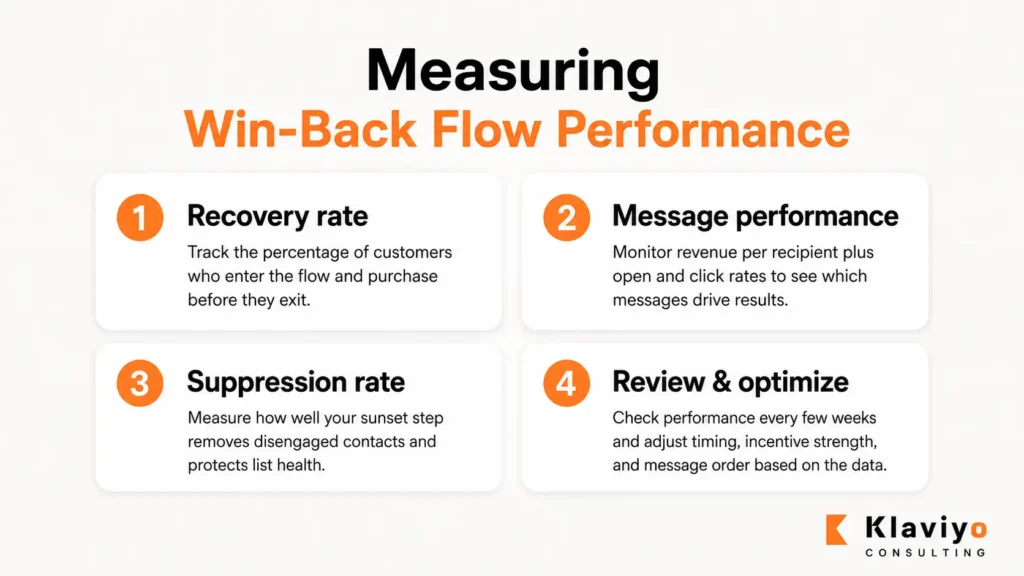
To know whether your win-back flow is working, track the metrics that connect directly to revenue and list health rather than vanity numbers alone.
Focus on the recovery rate, which is the percentage of entered customers who purchase before exiting the flow. Pair that with revenue per recipient, open and click rates per message, and the suppression rate from your sunset step. Together these tell you whether the flow is recovering customers, which message does the heavy lifting, and how cleanly it is removing dead weight from your list.
Review performance every few weeks and adjust your timing, incentive strength, and message order based on what the data shows. A win-back flow is never truly finished. It improves as you learn how your specific customers respond.
Ready to Recover More Lapsed Customers?
If you would like a tailored plan for your store’s win-back strategy, contact our team to talk through your customer data, purchase cycles, and re-engagement goals. A short conversation can help you prioritize the changes most likely to bring lapsed buyers back.
Conclusion
Building a win-back flow in Klaviyo is one of the most efficient ways to protect revenue you have already earned. Instead of chasing new customers at rising acquisition costs, you re-engage people who already know and trust your brand, while keeping your list healthy and your deliverability strong.
The strongest flows combine smart timing based on real purchase behavior, thoughtful segmentation, genuine personalization, and a sequence that leads with value before reaching for a discount. Add clear measurement and ongoing testing, and your win-back flow becomes a compounding asset rather than a one-time setup.
Start by reviewing your average purchase cycle and your inactive segments, then map out your message sequence using the structure above. From there, build, launch, and refine. The customers worth recovering are already sitting in your list, waiting for the right reason to come back.