Key Takeaways:
- Upsell and cross-sell flows in Klaviyo are automated email and SMS sequences that recommend a better version of a product or a complementary product after a customer buys.
- Upselling moves a customer to a higher-value option, while cross-selling adds a related item the two need different triggers, timing, and copy.
- Product-level triggers, purchase history filters, and clean catalog data matter more than clever design when building these flows.
- Timing should follow the product’s real consumption or usage cycle, not an arbitrary three-day delay.
- Segmentation, conditional splits, and suppression rules prevent your flows from recommending items customers already own.
- Start with one flow for your best-selling product, measure revenue per recipient, then expand to the rest of your catalog.
E-commerce brands spend most of their Klaviyo budget on acquiring the first order. The larger opportunity usually sits after that order clears. Upsell and cross-sell flows in Klaviyo let you recommend the right next product automatically, at the moment a customer is most receptive, without adding manual work to your marketing calendar.
This guide walks through how these flows work, how upselling differs from cross-selling in practice, how to build both inside Klaviyo, what data you need first, and the mistakes that quietly hold performance back. If you have not built an automation in Klaviyo before, start with our pillar guide on how to set up your first Klaviyo flow and then return here.
What Are Upsell and Cross-Sell Flows in Klaviyo?
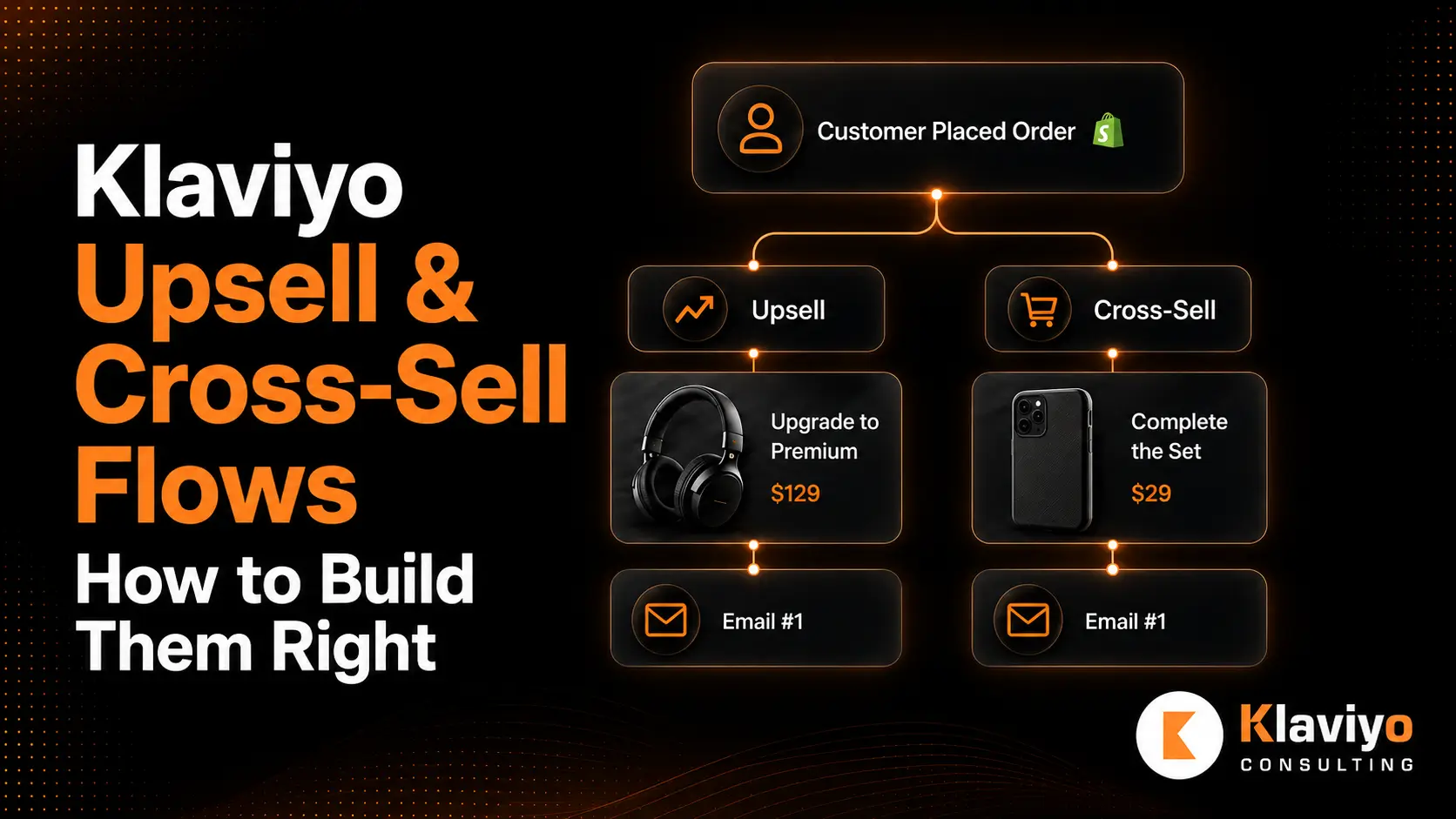
An upsell or cross-sell flow in Klaviyo is an automated sequence triggered by a purchase or product-related event that recommends an additional or upgraded product to the customer.

The upsell version encourages a move to a premium, larger, or longer-term option. A customer who bought a 30-day supply receives a message about the 90-day bundle and its lower per-unit cost. The cross-sell version suggests something that pairs naturally with what they already own. A customer who bought a camera body receives a message about lenses, straps, and memory cards.
Both live in Klaviyo’s Flows section and use the same building blocks you already know: a trigger, conditional splits, time delays, and email or SMS messages. What separates them from a standard receipt or thank-you sequence is that the product logic drives everything. The trigger filters on what was bought, and the content changes based on that answer.
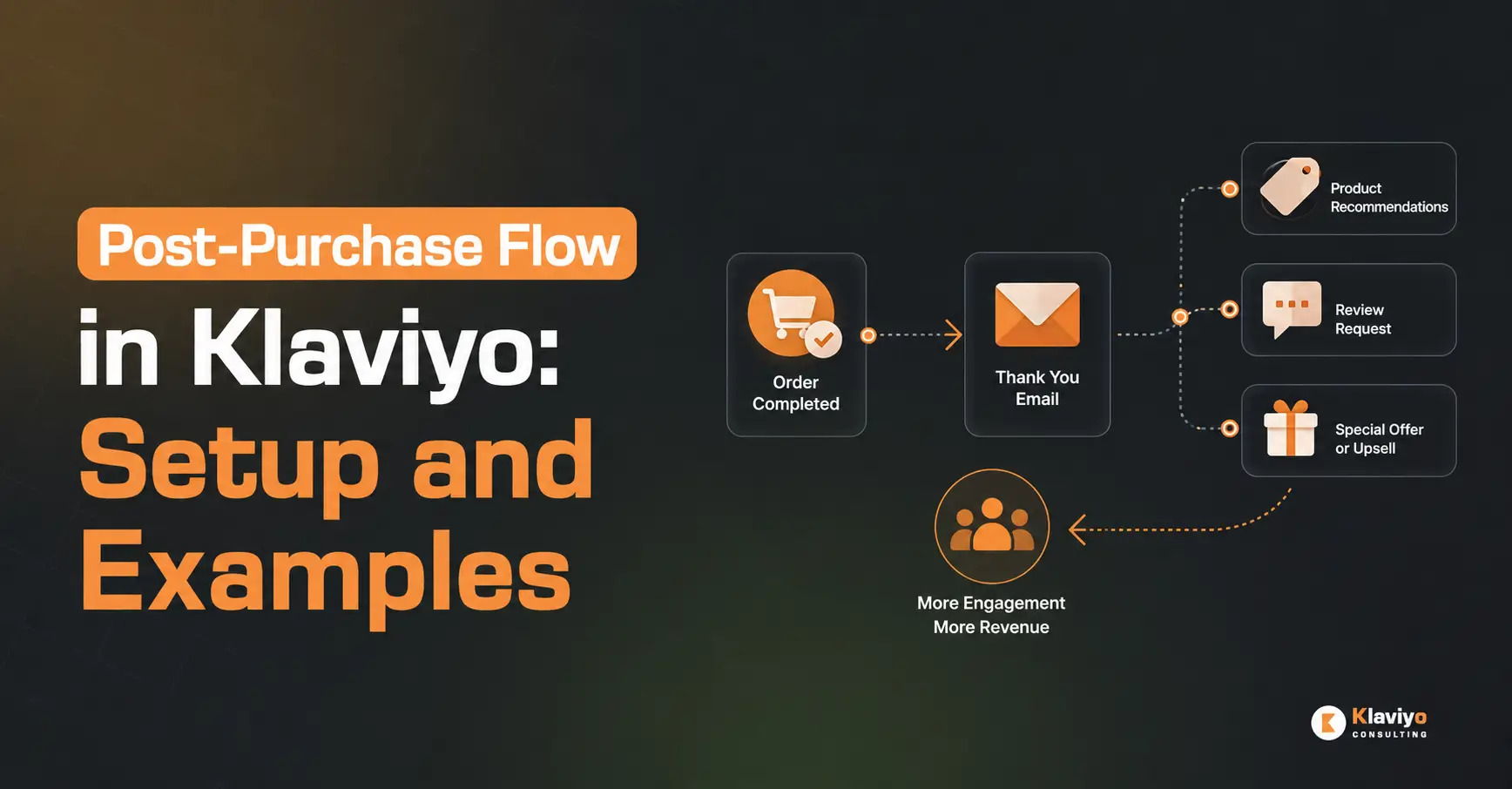
These flows sit inside a broader lifecycle system. They work alongside your post-purchase flow setup, your welcome series, and your win-back campaigns rather than replacing any of them.
Why Upsell and Cross-Sell Flows Matter for E-Commerce Revenue
These flows matter because they raise average order value and customer lifetime value using an audience that has already paid you and already trusts your fulfillment.
A first-time buyer has cleared the hardest hurdle. They have handed over payment details, received the product, and formed an opinion about your brand. Selling a second item to that person requires far less persuasion than convincing a cold visitor to buy anything at all. That is why post-purchase automations generally show stronger engagement than broadcast campaigns sent to a full list.
There are three practical benefits worth naming:
- Higher order value without higher ad spend. Revenue comes from owned channels rather than paid traffic.
- Faster second purchases. A well-timed recommendation shortens the gap between order one and order two.
- Better catalog discovery. Customers learn about products they would never find by browsing.
For a deeper look at the economics behind this, see our guide on how to launch post-purchase flows that increase LTV in Klaviyo.
Upsell vs Cross-Sell: Understanding the Difference
Upselling increases the value of the same purchase decision. Cross-selling expands the purchase into a related category. Treating them as one tactic is the most common reason these flows underperform.
The differences show up in three places:
- Trigger timing. Upsells often work best before the consumption cycle ends, when the customer is deciding whether to reorder. Cross-sells work best shortly after delivery, while the product is new and interest is high.
- Message framing. Upsells lean on value, convenience, and savings per unit. Cross-sells lean on completion, use cases, and getting more from what the customer already bought.
- Product logic. Upsells map one product to a bigger version of itself. Cross-sells map one product to a set of companions, which means you need pairing rules for each SKU.
A subscription coffee brand illustrates the split cleanly. The upsell is the larger bag or the subscription plan. The cross-sell is the grinder, the filters, and the travel mug. Same customer, two very different conversations.
How to Set Up an Upsell Flow in Klaviyo Step by Step
Build the upsell flow around a single product family first, prove it works, then replicate the structure.
Choose the Trigger and Filter It by Product
Use the Placed Order metric as your trigger. Then add a trigger filter so only buyers of the relevant product enter. Filter on the item name, product ID, collection, or a tag from your catalog. Without this filter, every customer sees the same recommendation and relevance collapses.
Set a Delay That Matches the Product Cycle
Delay length should reflect how long the product lasts. A 30-day supplement suits a delay of roughly 21 to 25 days, so the message arrives while supply is running low. A durable product with a long replacement cycle needs weeks or months. Guessing here is expensive, so use your own repeat-purchase data where you have it.
Add Conditional Splits and Suppression Logic
Add a conditional split that checks whether the customer has already purchased the upgrade. If they have, skip the message or route them to a different branch. Also exclude anyone with an open return or a recent support ticket if you sync that data into Klaviyo.
Write Two to Three Messages, Not One
A single email leaves value on the table. A short sequence works better: the first message introduces the upgrade and its benefit, the second answers objections such as cost or commitment, and the third offers a light incentive or a deadline. Keep each message focused on one idea.
How to Build a Cross-Sell Flow in Klaviyo
A cross-sell flow needs product pairing rules before you touch the flow builder. Decide which items belong together, then encode those pairs in Klaviyo.
Start by listing your top ten to fifteen sellers. For each one, write down two or three products that genuinely improve the experience of owning it. Base this on order data where possible: look at what customers who bought item A purchased next. Guesswork produces recommendations that feel random, and random recommendations train people to ignore your emails.
Once the pairs exist, build the flow like this:
- Trigger on Placed Order with a filter for the anchor product.
- Add a short delay, usually timed to a few days after expected delivery.
- Use a conditional split for each anchor product, or use dynamic blocks driven by customer properties.
- Add a filter that excludes anyone who already owns the recommended item.
Dynamic content keeps this manageable at scale. Instead of building twelve near-identical branches, store a pairing value as a profile property and render the recommendation dynamically. Our guide on personalizing Klaviyo emails with dynamic tags and custom properties covers the setup in detail.
Adding SMS to the sequence can lift response for time-sensitive offers, though it needs its own consent and cadence rules. Review when, why, and how to use SMS marketing in Klaviyo before layering it in.
The Segmentation and Data You Need Before You Launch
Upsell and cross-sell flows only work when your product and customer data are clean. Fix the data layer first.
Check these items before building:
- Catalog sync. Confirm your Shopify, WooCommerce, or custom integration is passing product names, IDs, images, and prices correctly.
- Purchase history. Make sure historical orders exist in Klaviyo so your exclusion filters actually catch previous buyers.
- Predictive data. Where enough order history exists, Klaviyo’s predicted values can help you separate high-value customers from one-time buyers.
- Custom properties. Store attributes such as size, plan tier, or preferred category so recommendations can respond to them.
Segmentation then determines who deserves which message. A repeat customer with a strong order history can handle a premium upsell. A first-time buyer of a low-priced item usually responds better to a modest cross-sell. Our breakdown of 7 powerful Klaviyo segmentation strategies and our guide to using Klaviyo’s predictive analytics to drive repeat purchases both help here.
Work With Klaviyo Consultants to Build Flows That Fit Your Catalog
Product pairing logic, conditional splits, and suppression rules get complicated quickly once your catalog passes a few dozen SKUs. If you would rather have the architecture designed and built correctly the first time, our Klaviyo consulting services cover flow strategy, technical setup, segmentation, and ongoing optimization for e-commerce brands. Review the service page to see how the engagement works and which deliverables fit your stage of growth.
Email Copy and Offer Angles That Make Recommendations Feel Helpful
The best upsell copy reads like advice, not a sales pitch. Lead with the customer’s outcome, then introduce the product as the way to reach it.
Angles that tend to work:
- Usage guidance. Explain how to get more from the item they bought, then name the product that helps.
- Bundle logic. Show the per-unit or shipping saving of buying the larger option.
- Social proof. Reference what other customers commonly pair with the item, provided your data supports the claim.
- Reorder convenience. Remind them that the supply is running low and make reordering a single tap.
Subject lines deserve the same attention as the body. Test specific product references against curiosity-led lines, and let the data decide. Our guide on using Klaviyo’s A/B testing tools for subject lines and content explains how to run tests that produce usable answers rather than noise.
Keep design simple. One clear product block, one visible price, one button. Long emails with five recommendations tend to split attention and lower clicks.
Common Mistakes That Limit Upsell and Cross-Sell Flow Performance
Most underperforming flows fail for structural reasons rather than creative ones. These are the issues we see most often:
- Recommending products the customer already owns. Missing exclusion filters make your brand look like it is not paying attention.
- Sending too early. A cross-sell that arrives before the first package does feels pushy.
- Ignoring the consumption cycle. Generic delays disconnect the message from the customer’s actual need.
- Over-discounting. Training buyers to expect a code on every follow-up erodes margin permanently.
- Flow overlap. Upsell messages colliding with abandoned cart, browse abandonment, and campaign sends create fatigue. Smart sending and flow filters reduce the collision risk.
- No measurement plan. Open rate tells you little here. Track revenue per recipient, conversion rate, and average order value by flow branch.
If your wider automation coverage has gaps, our list of the top 10 email flows every Shopify store should set up in Klaviyo is a useful audit checklist.
Ready to Turn Post-Purchase Moments Into Predictable Revenue?
If you want a second opinion on your current flow structure, or help mapping upsell and cross-sell logic across your full catalog, get in touch with our team to talk through your setup. Share your platform, catalog size, and current flow list, and we will tell you where the clearest opportunities sit.
Final Thoughts
Upsell and cross-sell flows in Klaviyo turn a completed order into the start of a longer customer relationship. The mechanics are straightforward: a product-filtered trigger, a delay that matches real usage, conditional logic that respects purchase history, and copy that reads like guidance. The difficulty lies in the details: clean catalog data, honest product pairings, and disciplined timing.
Begin with one flow built around your best-selling product. Measure revenue per recipient over a full cycle, adjust the delay and offer based on what you see, then expand the structure across the rest of your catalog. Pair these flows with a solid welcome series, well-tuned abandoned cart emails, and an active win-back flow, and your automation program will carry a meaningful share of total revenue.